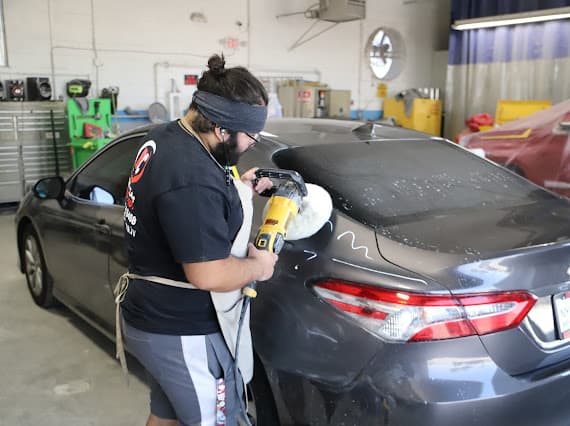
Dents are a fact of life in Las Vegas. Crowded casino parking structures, heavy traffic on Sahara and Tropicana, and the occasional shopping cart are constant threats to your vehicle's body panels. The good news is that many dents can be fixed quickly and affordably using paintless dent repair - without any repainting.
What Is Paintless Dent Repair (PDR)?
Paintless dent repair is a technique where a technician uses specialized rods and tools to carefully massage a dent from the inside of a panel, restoring its original shape without disturbing the paint surface. When done correctly, the result is completely invisible - the paint is untouched and the metal returns to its factory contour.
PDR is typically faster and less expensive than traditional dent repair because it eliminates the need for body filler, primer, and paint. It also preserves your vehicle's original factory paint, which is important for resale value.
Types of Dents That PDR Can Fix
- Parking lot door dings - the most common PDR candidate
- Minor hail damage - small, shallow dimples across a panel
- Minor impact dents with intact paint - shopping carts, minor contact
- Rounded dents without sharp creases in the metal
Types of Dents That Need Traditional Repair
PDR has limits. When the damage exceeds those limits, traditional repair using body filler and paint is the appropriate method.
- Dents with paint damage - chips, scratches, or cracked paint require refinishing regardless
- Sharp creases - metal with a sharp fold cannot be fully massaged back without some distortion
- Deep, complex dents - some shapes cannot be reliably restored to factory contour with PDR
- Dents on edges or character lines - these areas are difficult to access and restore with PDR tools
- Dents where the paint has stretched significantly and would crack during the repair process
Cost Comparison: PDR vs. Traditional Dent Repair
PDR is generally less expensive than traditional repair because no body filler or paint is required. The cost depends on the number of dents, their size, and their location. A single door ding may be a quick, affordable repair. Widespread hail damage with many dents across multiple panels takes more time but is still typically less than full panel repainting.
How Las Vegas Heat Affects Dent Repair
Las Vegas temperatures frequently exceed 110 degrees in summer. This affects both the dent repair process and the condition of your paint. Extreme heat makes metal more pliable, which can actually assist the PDR process. However, it also means that paint on older vehicles may be more brittle and less tolerant of the tension created during repair.
Hot weather also means that adhesive-based PDR tools - which pull dents from the outside using glue tabs - perform differently than in cooler temperatures. Experienced PDR technicians account for Las Vegas conditions when selecting tools and techniques.
The Repair Process at Best Class Auto Body
When you bring your vehicle in, a technician assesses the dent to determine whether PDR is appropriate. If PDR is the right choice, the technician accesses the panel from behind using specialized tools and carefully works the metal back to its original contour. The result is inspected under focused lighting to verify the repair is complete and invisible.
If traditional repair is needed, the technician will explain why and what the repair process involves.
Related Services at Best Class Auto Body:
Frequently Asked Questions
How long does PDR take?
A single door ding or small dent can often be completed in an hour or less. Multiple dents or larger damage may take a half day to a full day. Your technician can give you a timeline estimate after assessing the damage.
Does insurance cover PDR?
Dent repair from collisions is typically covered under collision coverage. Hail damage is typically covered under comprehensive coverage. Contact your insurance carrier to confirm your coverage before scheduling.
Is PDR a permanent fix?
Yes. A properly completed PDR repair is permanent. The metal is returned to its original shape. There are no fillers to shrink or paint to peel at the repair site.
Can PDR be done on aluminum panels?
Yes, but aluminum requires different techniques than steel. Aluminum is more prone to work-hardening, meaning it can crack if manipulated too aggressively. Technicians trained in aluminum PDR use appropriate tools and methods. Many modern vehicles use aluminum body panels extensively.